
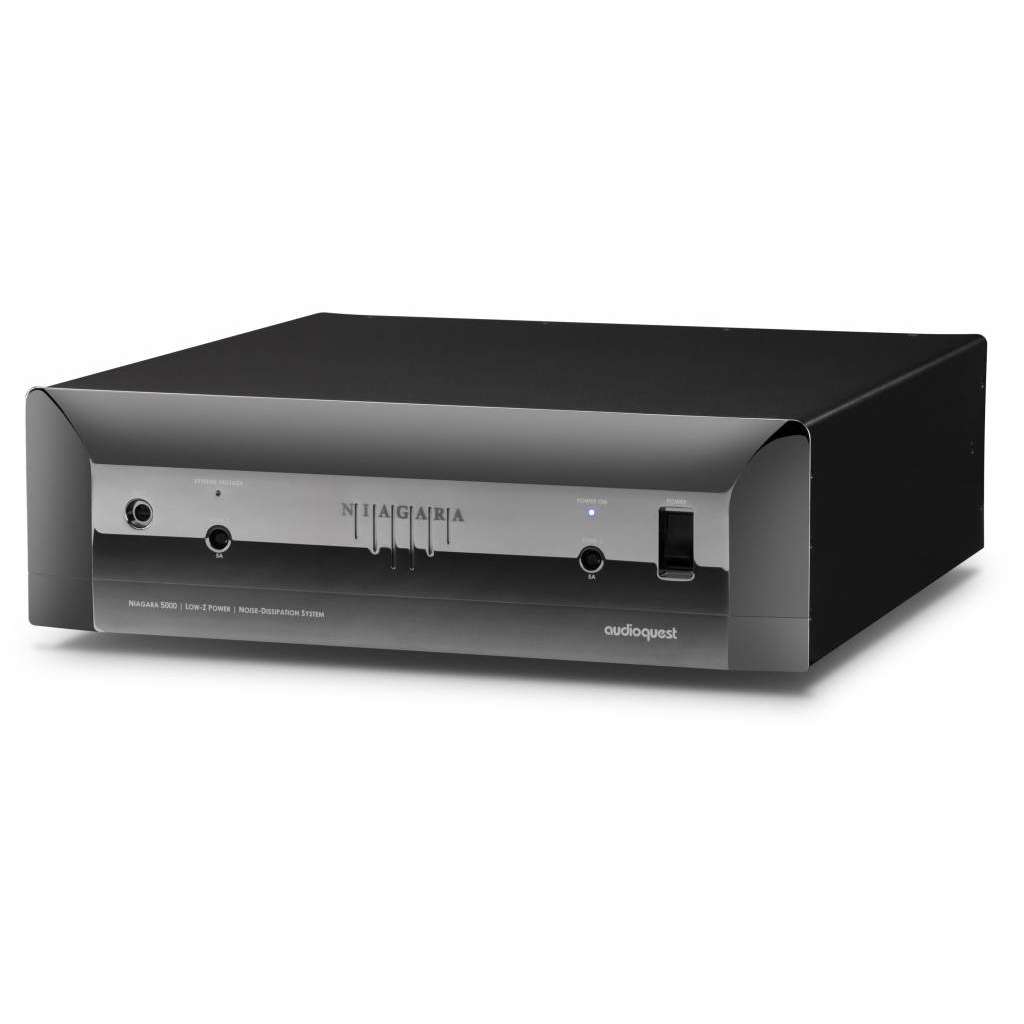
AUDIOQUEST Niagara 5000 Power Conditioner

- 90 Amps Peak AC Transient Power Correction
- Patented Ground Noise-Dissipation Technology
- Maximum RMS Input Current: 20 Amps (RMS)
- Transient Surge Suppression
- NOTE: AC Power Cable is extra (20 amp C19 female end required for Niagara 5000)
$8,900.00
Niagara 5000
Low-Z Power | Noise-Dissipation System
Redefining the Science of Power Conditioning

ÑWilliam E. Low, Founder and CEO, AudioQuest
The science of AC power delivery is not a simple one; it demands focus, and the devil is in the details. In fact, the great increase in airborne and AC-line-transmitted radio signals, combined with overtaxed utility lines and the ever-increasing demands from high-definition audio/video components, has rendered our utilitiesÕ AC power a somewhat antiquated technology.
Where Alternating Current (AC) is concerned, weÕre relying on a century-old technology created for incandescent lights and electric motorsÑtechnology that was certainly never meant to power the sophisticated analog and digital circuits used in todayÕs premium audio/video systems. To properly accom-modate the promise of todayÕs ever-increasing bandwidth and dynamic range, we must achieve extraordinarily low noise across a very wide range of frequencies.
Further, todayÕs power amplifiers are being taxed for instantaneous peak-current demand, even when theyÕre driven at modest volumes. Although we have seen a substantial increase in dynamics from much of our audio software, the loudspeakers we employ to reproduce them are often no more efficient than they were two to four decades ago. This places great demands on an amplifierÕs power supply, as well as the source AC power supplying it.
Our systemsÕ sensitive components need better alternating currentÑa fact that has resulted in a host of AC power conditioning, isolation transformer, regeneration amplifier, and battery back-up system topologies. Through differential sample tests and spectrum analysis, it can be proven that up to a third of a high-resolution (low-level) audio signal can be lost, masked, or highly distorted by the vast levels of noise riding along the AC power lines that feed our components. This noise couples into the signal circuitry as current noise and through AC ground, permanently distorting and/or masking the source signal.
Given that the stakes are so high, all sincere attempts to solve this problem must be applauded.
Once the audio/video signal is gone, itÕs gone foreverÉ
For AudioQuest, honoring the source is never a matter of simply using premium Òaudiophile-grade partsÓ or relying on a proprietary technologyÑcommon approaches within our community. For years, we have all been witness to the same, seemingly endless audiophile debates: valves versus transistors; analog versus digital; can cables really make a difference?; and on and on. While we, too, can brag about our many unique technologies, we realize that true audio/video optimization is never a matter of any one secret or exotic circuit. When it comes to noise filtering for AC power, many approaches can yield meaningful results. However, these approaches may also impart ringing, current compression, and non-linear distortions that can render the cure worse than the disease!
The Niagara 5000 features our patented AC Ground-Noise Dissipation, the widest bandwidth-linearized AC filter in the industry, and our unique passive/active Transient Power Correction Circuit. Boasting an instantaneous current reservoir of over 90 amps peak, the Niagara 5000 is specifically designed for todayÕs current-starved power amplifiers. Many AC power products featuring Òhigh-current outletsÓ merely minimize current compression; the Niagara 5000 corrects it.
Though itÕs easy to tout a given technology, itÕs quite another thing to create a solution that is consistent, holistic, functional, and that honors verifiable science. ItÕs not enough to reduce AC line noise and its associated distortions at just one octave, thus leaving vulnerable the adjacent octaves and octave partials to noise, resonant peaking, or insufficient noise reduction. Consistency is key. We should never accept superior resolution in one octave, only to suffer from masking effects a half-octave away and ringing artifacts two octaves from there. This is the principal criterion for AudioQuestÕs Low-Z Power Noise-Dissipation System.
The Niagara 5000 represents over 20 years of exhaustive research and proven AC power products designed for audiophiles, broadcast engineers, and professional-audio applications. Every conceivable detail has been addressed: In the Niagara 5000, youÕll find optimized radio-frequency lead directionality, capacitor run-in forming technologies developed by Jet Propulsion Laboratories and NASA, and AC inlet and outlet contacts with heavy silver plating over extreme-purity copper, assuring the tightest grip possible.
A great system is built from a solid foundation, and that foundation starts with power. With an AudioQuest Niagara 5000, youÕll experience for the first time the clarity, dimensionality, frequency extension, dynamic contrast, and grip your system has always been capable of deliveringÑif only the power had been right!
We welcome you to experience the Niagara 5000 and hear firsthand the remarkable results of highly optimized power management: startlingly deep silences, stunning dynamic freedom, outstanding retrieval of ambience cues, and gorgeous delineation of instruments and musicians in space. Once youÕve experienced it, it may seem so elegant, so logical, and so obvious that you find yourself wondering why it hadnÕt been done before.
Downloads & Links
- Power Demystified (download)
- AQ Declaration of Conformity Niagara Series 2020
- Owner’s Manual EN / UK / EU / AP / DE / FR / NL / RU / SC / SP
- Quick Start Guide EN / UK / EU / AP / FR / DE / SP / IT / NL / SE / PL / PT / RU / SC
- Warranty Registration
- FAQs

SPECIFICATIONS
- Transient Power Correction: 90 amps peak. Provides a current reservoir for any power amplifier (up to 25mS)
- Level-X Ultra-Linear Noise-Dissipation Technology: More than 23 octaves differential-mode filtering (3kHzÐ1GHz in excess of 24dB reduction) and 16 octaves common-mode filtering (20kHzÐ100MHz in excess of 30dB reduction) with linear response, optimized for varying line and load impedance
- Patented Ground-Noise Dissipation. (All outlets): 6 banks of direction-controlled ground-noise dissipation
- Non-Sacrificial Surge Protection: Withstands multiple AC surges and spikes up to 6000V/3000A without sustaining damageÑsonically non-invasive
- Maximum RMS Input Current: 20 Amps (RMS)
- Outlets: Source (8); High-Current (4)
- Dimensions: 17.5Ó W x 5.875Ó H (5.24Ó H without feet) x 17.2Ó D (3-RU Rack Mount Kits Optional)
- Weight: 44lbs. (US); 19.9kg.
- View Declaration of Conformity
VIEW THE INTERNAL WORKINGS OF THE NIAGARA 5000
Niagara 5000 Common-Mode Noise Dissipation
Niagara 5000 Surge Suppression
Niagara 5000 Extreme Voltage Shutdown
Based on 0 reviews
Be the first to review “AUDIOQUEST Niagara 5000 Power Conditioner”
You must be logged in to post a review.
There are no reviews yet.